AMA In-Text Citations: How Superscript Numbers Work
How AMA In-Text Citations Work
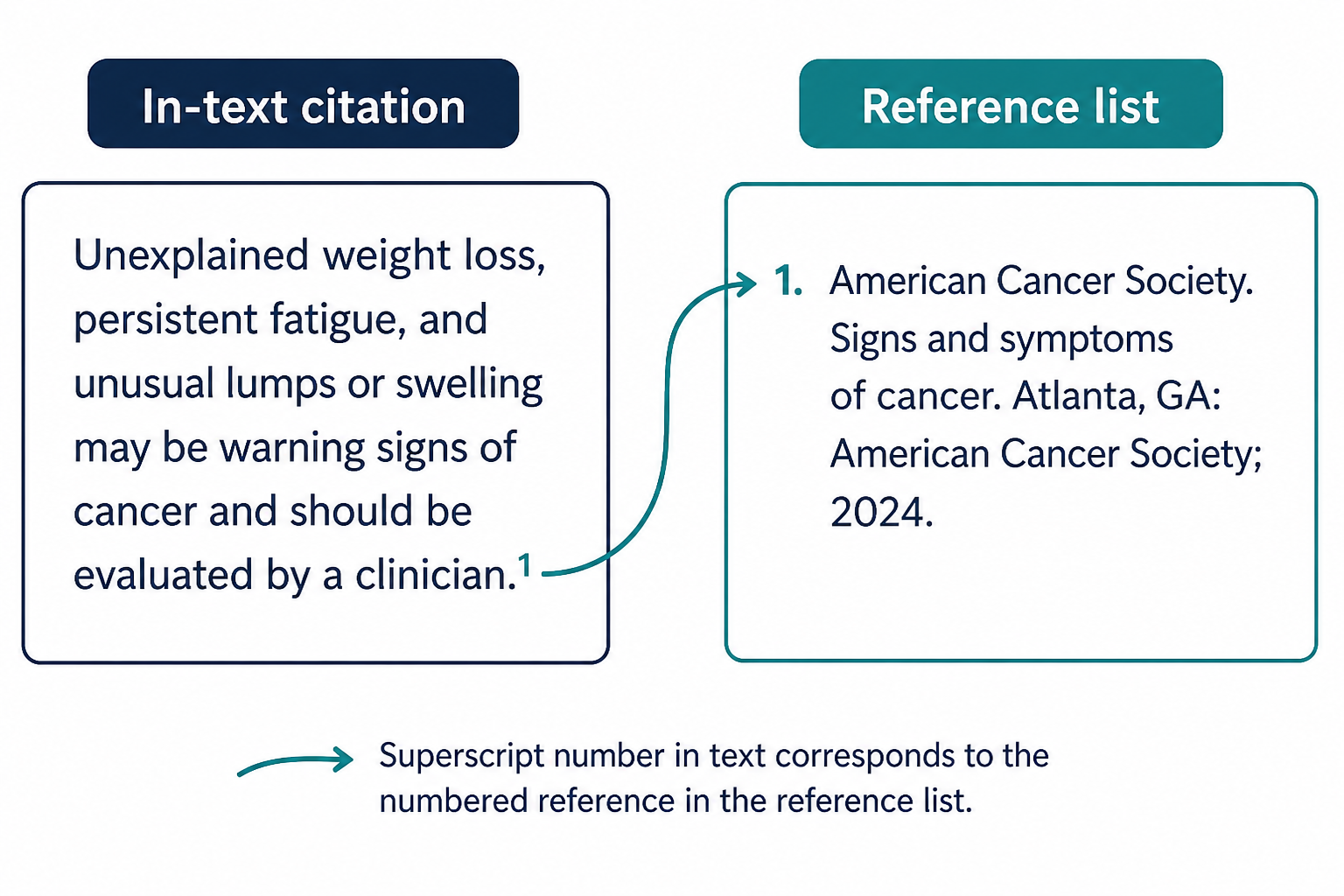
AMA in-text citations are superscript arabic numbers placed in the text where a source supports a claim. Each source is numbered in the order it first appears, and that same number is reused every time the source is cited again. The number points to the matching entry in the numbered reference list at the end of the paper.
American Medical Association (AMA) style is a numbered citation system. Only a small number appears in the body text, not an author and a year. The AMA Citation Generator assigns and tracks these numbers automatically, and this guide explains how the numbering, placement, and reference matching work under the AMA Manual of Style, 11th edition.
What an AMA In-Text Citation Looks Like
An AMA in-text citation is a superscript number attached to the relevant word, with no brackets and no space before it:
Home blood-pressure monitoring improves control in adults with hypertension.¹
The superscript 1 marks the first source cited in the paper and points to reference 1 in the list. The citation carries no author name, no year, and no page number in the basic form, because all of that detail lives in the reference-list entry the number refers to.
How the Numbering Works
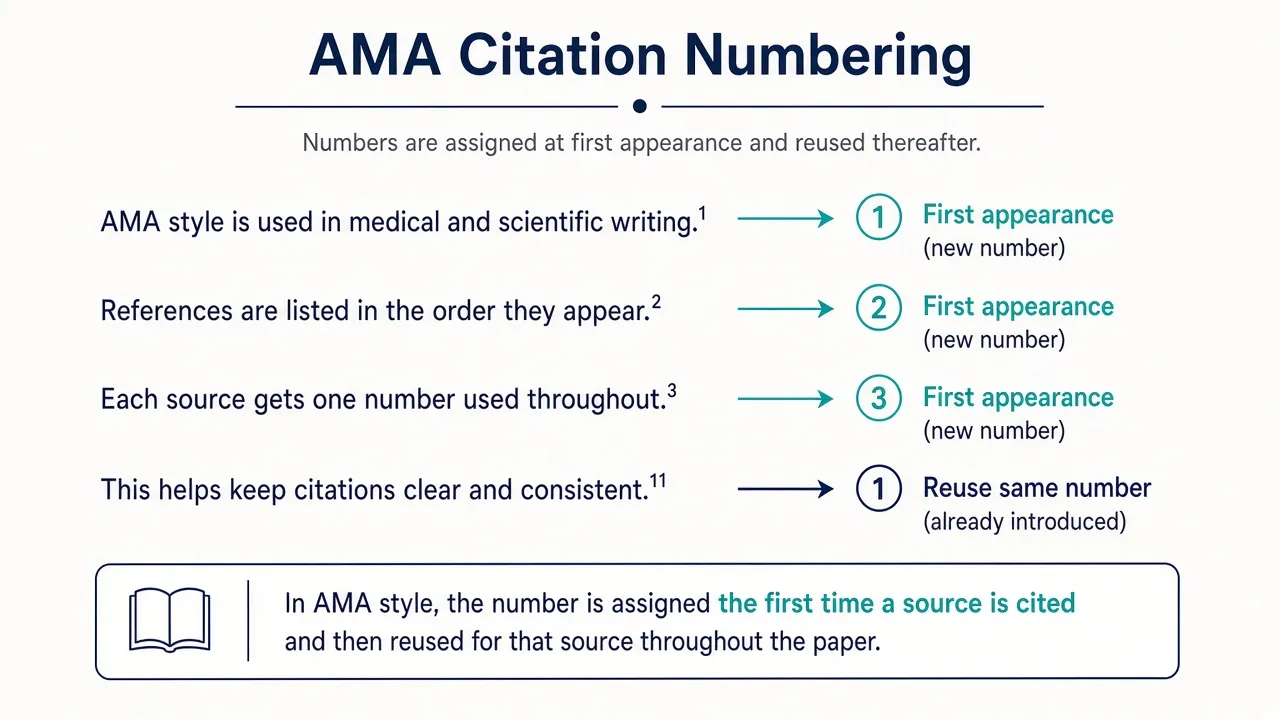
AMA assigns numbers in the order sources first appear in the text. The first source cited becomes 1, the next new source becomes 2, and the sequence continues through the paper. A source keeps its number for the whole document, so the fourth source cited stays 4 even when it is used again on the last page.
Reusing the number is the rule that surprises writers from author-date styles. When you cite source 2 again later, you write a superscript 2 again rather than giving it a new number. The reference list is then ordered by these numbers, not alphabetically, so reference 1 is the first source cited rather than the first author alphabetically. The AMA in-text citation generator renumbers the whole paper when you add or remove a source.
Where to Place the Superscript Number
Place the superscript number immediately after the word, phrase, or clause it supports. Its position relative to punctuation follows a fixed rule: the number goes outside periods and commas, and inside colons and semicolons. A citation at the end of a sentence sits after the period.
The trial reported a significant reduction in blood pressure.²
When the citation supports a specific word rather than the whole sentence, attach it to that word:
The Framingham study² established several cardiovascular risk factors, while later work³ refined them.
The number attached to the exact term it supports tells the reader which claim each source backs. That matters when one sentence draws on several sources.
How to Cite Multiple Sources at Once
When several sources support one point, list their numbers together, separated by commas with no spaces:
Several trials confirmed the effect.¹,⁴,⁷
For three or more consecutive numbers, use a hyphen to show the range instead of listing each one. Sources 2, 3, and 4 become 2-4:
The reviews reached the same conclusion.²⁻⁴
Both styles combine in one citation when the sources are a mix of consecutive and separate, such as 1,3-5,8. A compressed range keeps a citation with many sources short and readable.
How In-Text Numbers Match the Reference List
Every in-text number corresponds to one entry in the reference list, and the list is ordered by those numbers. Superscript 5 in the text points to reference 5 in the list, which gives the full source details. The two are locked together, so adding a new source early in the paper shifts every later number and its reference entry.
That is why manual renumbering goes wrong in a long paper. Moving a paragraph or inserting a source by hand means renumbering every citation and reference that follows. The guides on citing a website and a journal article in AMA style cover how to build the reference entries that these numbers point to.
Key Takeaways
- AMA in-text citations are superscript arabic numbers, assigned in the order sources first appear.
- A source keeps its number for the whole paper and reuses it on every later citation.
- The number goes outside periods and commas, and inside colons and semicolons.
- List multiple sources with commas and no spaces (1,4,7), and use a hyphen for a range of three or more (2-4).
- Each number matches one entry in a reference list ordered by number, not alphabetically.
Frequently Asked Questions
How do AMA in-text citations work?
AMA in-text citations are superscript arabic numbers placed where a source supports a claim. Each source is numbered in the order it first appears in the text, and that same number is reused every time the source is cited again. The number points to the matching entry in the numbered reference list.
Where do you place the superscript number in AMA style?
Place the AMA superscript number immediately after the word or phrase it supports, outside periods and commas but inside colons and semicolons. When it refers to a specific author named in the sentence, place it directly after the author’s name. The number has no space before it and no brackets.
How do you cite multiple sources in one AMA in-text citation?
List the numbers together separated by commas with no spaces, such as 1,4,7. For three or more consecutive numbers, use a hyphen to show the range, so sources 2, 3, and 4 become 2-4. Combine both styles when needed, for example 1,3-5,8, to keep the citation compact.
Do AMA in-text numbers go in order?
Yes. AMA assigns numbers in the order sources first appear in the text, so the first source cited is 1, the next new source is 2, and so on. The reference list is then ordered by those numbers rather than alphabetically, which is the opposite of author-date styles like APA.
What is the difference between AMA and APA in-text citations?
AMA uses superscript numbers in order of appearance, while APA uses the author’s surname and the year in parentheses. AMA numbers point to a numbered reference list, and APA names point to an alphabetical list. AMA keeps the sentence uncluttered, since only a small number appears in the text.
Conclusion
AMA in-text citations use one system: a superscript number assigned in order of first appearance, reused for every later citation, and matched to a numbered reference list. Place the number outside periods and commas, group multiple sources with commas and hyphens, and let the reference list follow the numeric order. The AMA Citation Generator assigns and renumbers these citations so the text and the reference list always agree.
Sources
American Medical Association. AMA Manual of Style: A Guide for Authors and Editors. 11th ed. Oxford University Press; 2020. In-text reference numbering is covered in the references chapter. Official site: AMA Manual of Style.
Ready to run the numbers? Use the AMA Citation Generator.