AMA Journal Article Citation: Format & Examples
How to Cite a Journal Article in AMA Style
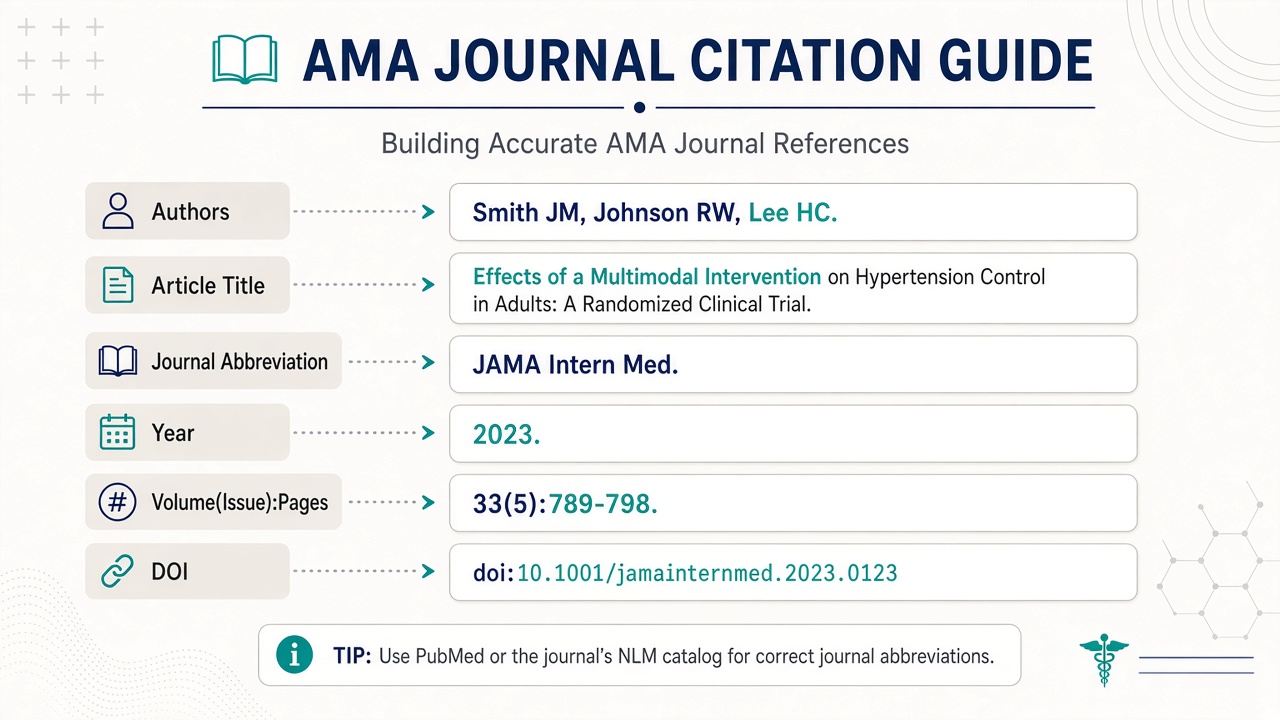
Cite a journal article in AMA style by listing the authors, the article title, the abbreviated journal name, the year, the volume and issue, the page range, and the DOI, in that order. The format is Authors. Article title. Journal Abbreviation. Year;Volume(Issue):Pages. doi:number. American Medical Association (AMA) style follows the AMA Manual of Style, 11th edition, and the journal article is the most common reference type in medical writing.
A small punctuation slip can change how a reader reads the reference, so journal citations need care. The AMA Citation Generator puts each element in the correct order, and this guide walks through every part so a generated or hand-built citation matches the manual. The rules here follow the journal-reference guidance in section 3.11 of the AMA Manual of Style, 11th edition.
The Elements of an AMA Journal Citation
An AMA journal citation has 7 elements in a fixed order:
- Authors, written surname first with initials, no periods between initials.
- Article title, in sentence case, capitalizing only the first word and proper nouns.
- Journal abbreviation, italicized, using the official National Library of Medicine short title.
- Year of publication, followed by a semicolon.
- Volume number, followed by the issue number in parentheses.
- Page range, after a colon, with a hyphen between the first and last page.
- DOI, the permanent digital identifier, preferred over a URL.
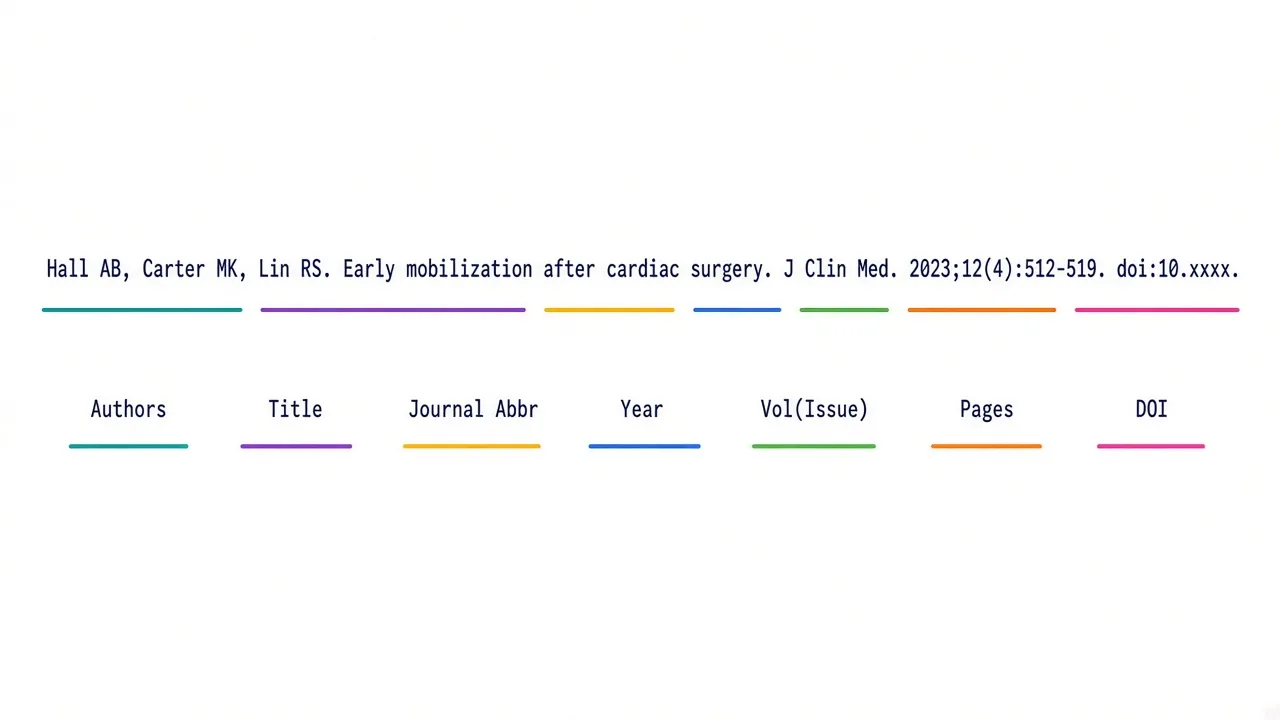
The year, volume, issue, and pages join together with no spaces: Year;Volume(Issue):Pages. Every other element ends with a period. The AMA journal article citation generator places each part in this order and handles the tight punctuation of the year-volume-page group.
AMA Journal Citation Format With Examples
A standard print journal article follows this format. The example below is a format demonstration, not a live reference:
Hall AB, Carter MK, Lin RS. Early mobilization after cardiac surgery: a randomized trial. J Clin Med. 2023;12(4):512-519.
An online article with a DOI adds the identifier at the end, and needs no access date because a DOI is permanent:
Okafor NL, Bianchi PR, Dawson LT. Remote monitoring in heart failure management. JAMA Intern Med. 2024;184(2):145-153. doi:10.1001/jamainternmed.2024.0012
The DOI is written as doi: followed by the number, with no space, and closes the reference. A DOI resolves to the article no matter how the publisher’s website changes, which is why AMA prefers it over a URL.
How Many Authors to List
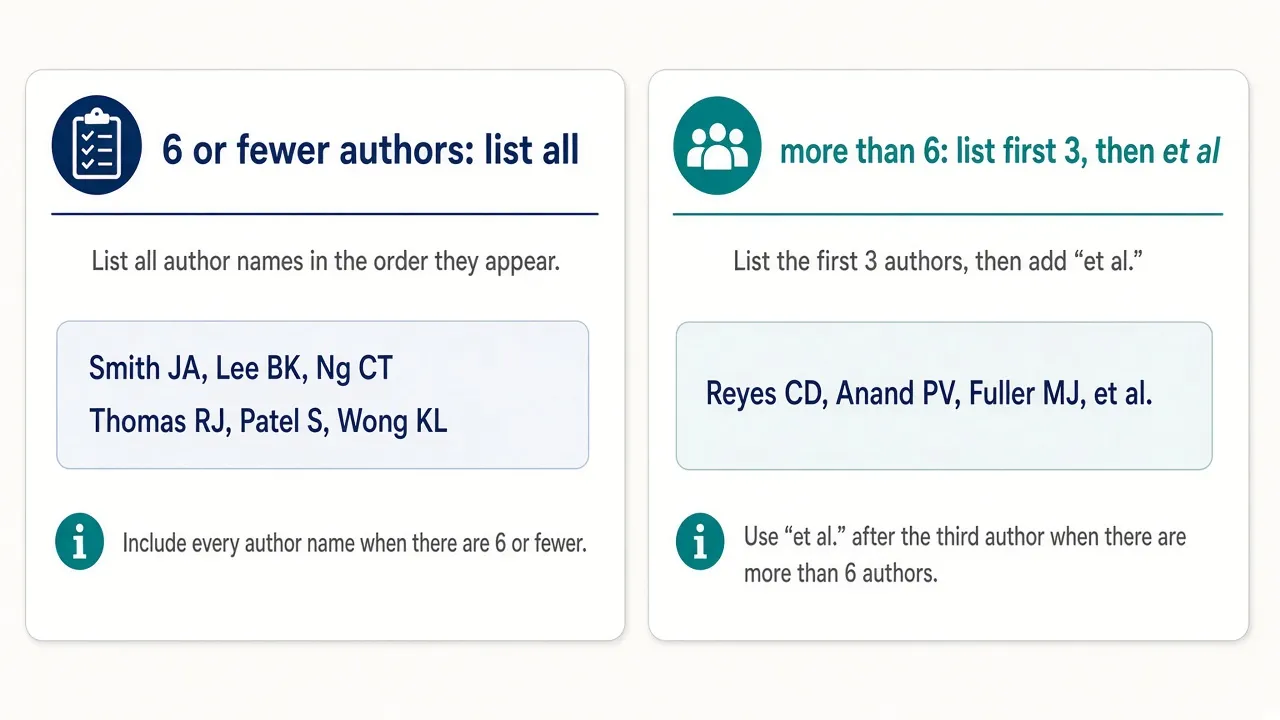
AMA style lists all authors when there are six or fewer, and shortens longer lists. When an article has more than six authors, list the first three, then add et al:
Reyes CD, Anand PV, Fuller MJ, et al. Sleep duration and metabolic risk in adolescents. Pediatrics. 2023;151(6):e2022059987.
Each author is written surname first, then initials with no periods and no spaces, so Jane A. Smith becomes Smith JA. Authors are separated by commas, and the final author is followed by a period before the article title. That keeps papers with many multi-author studies readable while still naming the lead researchers.
How to Abbreviate the Journal Name
AMA style abbreviates and italicizes the journal name using the official short title from the National Library of Medicine (NLM) Catalog. The New England Journal of Medicine becomes N Engl J Med, and the Journal of General Internal Medicine becomes J Gen Intern Med. A single-word journal name, such as Pediatrics, is not abbreviated.
Looking the title up in the NLM Catalog gives the exact abbreviation, including spacing and capitalization. Guessing rarely gets those details right. The abbreviation is italicized while the article title is not, so the two read as separate parts of the reference. This is one of the details the AMA in-text citation generator and the reference generator handle automatically.
Handling Missing Information
Journal articles sometimes lack an issue number, a volume, or page numbers, and AMA has a rule for each case:
- No issue number: give the volume directly followed by the page range, with no parentheses.
- No volume or issue: provide the month before the year to fix the publication date.
- No page numbers: use the article’s electronic identifier, such as e2022059987, in place of pages.
Online-only journals often number articles with an identifier rather than continuous pages, so the identifier takes the page position. When both a DOI and a URL exist, use the DOI alone, because it is the stable link. These rules keep the reference complete even when the article omits a traditional field.
AMA Journal Citation vs Website Citation
A journal citation and a website citation share the AMA structure but differ in three fields. A journal citation uses an abbreviated italic journal name, a volume and issue, and a page range, while a website citation uses the full website name, an access date, and no volume or pages. The DOI belongs to journal articles, and the access date belongs to web pages.
Choosing the right type starts with identifying the source: a peer-reviewed article in a journal is a journal citation even when read online, while a general web page is a website citation. The guide on how to cite a website in AMA style covers the web-page rules that pair with the journal rules here.
Frequently Asked Questions
How do you cite a journal article in AMA style?
List the authors surname first with initials, then the article title in sentence case, the abbreviated journal name in italics, the year, the volume with the issue in parentheses, the page range, and the DOI. The format is: Authors. Article title. Journal Abbreviation. Year;Volume(Issue):Pages. doi:number. Each element ends with a period except the parts joined by semicolons and colons in the year-volume-page group.
How many authors do you list in an AMA journal citation?
List every author when there are six or fewer. When there are more than six, list the first three authors followed by et al. Write each author as surname then initials with no periods and no spaces between initials, such as Smith JA, and separate authors with commas. This rule keeps long author lists short while still crediting the lead contributors.
Do you need a DOI in an AMA journal citation?
Include a DOI whenever the article has one, because it is a permanent link that never breaks. AMA prefers a DOI over a URL, and no access date is required with a DOI because it is a stable identifier. When an article has no DOI, use the URL instead and add an access date, since a plain URL can change or expire.
How do you abbreviate the journal name in AMA style?
Use the official abbreviation from the National Library of Medicine (NLM) Catalog, and italicize it. For example, the New England Journal of Medicine is abbreviated N Engl J Med, and the Journal of General Internal Medicine is J Gen Intern Med. Looking the title up in the NLM Catalog gives the exact abbreviation, including spacing and capitalization.
What do you do when a journal article has no issue number?
When an article has no issue number, omit the parentheses and give the volume followed directly by the page range. Some journals number pages continuously through a volume and do not use issues. If the article also lacks a volume, provide the month before the year, so the reference still points the reader to the right publication date.
Reference
American Medical Association. AMA Manual of Style: A Guide for Authors and Editors. 11th ed. Oxford University Press; 2020. Journal-reference rules appear in section 3.11. Official site: amamanualofstyle.com.
Ready to run the numbers? Use the AMA Citation Generator.